
Legal
How Evidence Shapes Texas Motorcycle Accident Compensation

With doctors assessing crash-related symptoms in the hospital, bikers injured in a Texas motorcycle collision face competing accounts of the driving while their families work out what missed work will cost. To tie those disputes to the crash, include the shifts you missed in your records. A specialist's written diagnosis can explain why headaches won't go away.
National Highway Traffic Safety Administration (NHTSA) figures put motorcyclist deaths at 6,228 in 2024, accounting for 16% of all traffic deaths. The Insurance Institute for Highway Traffic Safety (IIHS) put that year's motorcycle deaths at roughly three times the 1997 total, up 23% from 2019.
What Proof Matters Most in a Texas Motorcycle Injury Claim?
Without evidence, you can't show who was responsible or link the injury to the collision. Separate medical and financial records must show the money lost for each issue, along with the harm you suffered.
Police reports, scene records, and witness accounts
Check the crash report's driver and witness entries, then look for road conditions or any citations. That report doesn't decide who's civilly liable. What's in the report and how you'll use it decide whether it's admissible.
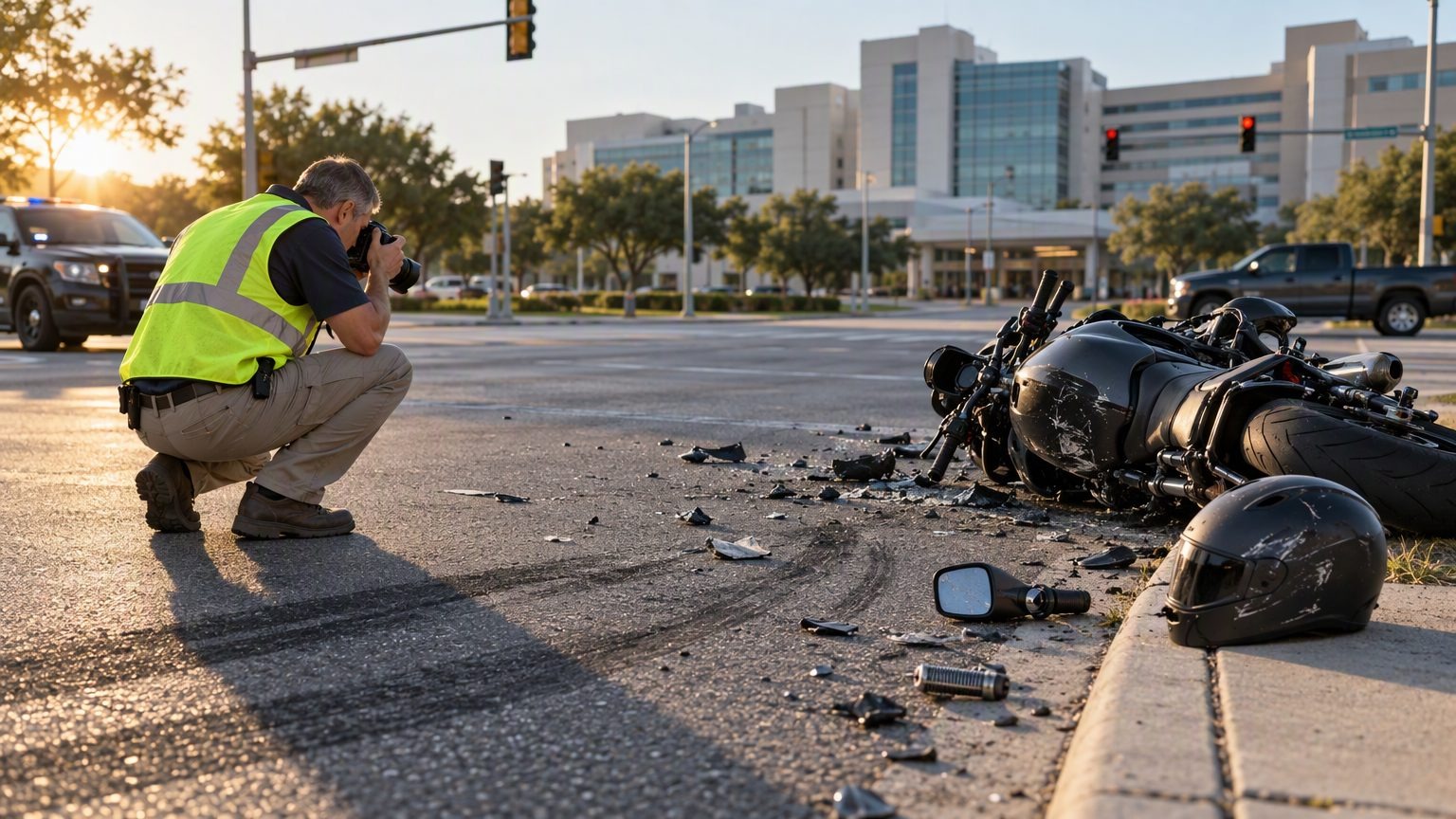
Photograph the vehicles where they stopped, showing their positions and impact damage along with skid or scrape marks, traffic controls, sight lines, debris and visible injuries. Before trusting a witness's account, check their view and how closely they watched, then record it promptly and check that it stays consistent.
Medical proof and the link between impact and injury
For the timing, look through emergency records and imaging. When treatment plans back up a specialist's notes, they can connect symptoms to the collision and document restrictions. With gaps in treatment, questions don't mean anything's fabricated. For a link that falls within common knowledge, you can use lay evidence of causation in limited circumstances under Guevara v. Ferrer, 247 S.W.3d 662 (Tex. 2007): You'll generally need an expert's testimony for medically complex links.

Income and property documentation
For diminished earning capacity, show how much less you can earn; lost wages cover missed pay. For missed assignments and the pay you'd otherwise have earned, use payroll and tax records backed by your employer's confirmation and medical restrictions. Document your motorcycle's damage with repair estimates and valuations. With your saved gear receipts, keep the towing bills.
How Evidence Changes Compensation Under Texas Fault Rules
The 51% threshold and percentage reduction
Under Texas Civil Practice and Remedies Code Chapter 33, your share of fault determines what you can recover. Above 50% fault, you're generally barred from recovery by Section 33.001. From the damages you'd otherwise recover, Section 33.012 subtracts your assigned fault percentage.
Assign a claimant 20% responsibility, and a supported $100,000 damages finding drops to $80,000, for example. Don't read that calculation as a settlement prediction. Set testimony that the motorcycle entered against a signal beside video of a turning vehicle's path; the fault percentages they suggest can differ.
National behavior data cannot establish individual fault
NHTSA reported that 37% of motorcycle riders involved in fatal crashes in 2024 had been speeding. NHTSA also reported 2,125 rider deaths in single-vehicle crashes, with alcohol impairment recorded in 40% of them. Those population figures can't prove that you sped or consumed alcohol, much less that you contributed to the collision in question. To show fault, use measurements or video from the crash, supported where relevant by toxicology results or reliable testimony.
Why Injured Bikers Often Face Long-Term Compensation Questions
Which injuries commonly follow motorcycle collisions?
With road rash and fractures, records commonly show lower-extremity trauma and head injuries; spinal injuries and internal trauma occur, too. You'll still need a diagnosis for your injuries.
NHTSA's 2024 motorcycle traffic-safety report puts estimated injuries at 86,887, up 5.2% from 82,567 in 2023. Per vehicle mile traveled in 2024, motorcyclists' death risk was nearly 27 times passenger-car occupants', NHTSA also found (the injury risk was almost five times as high).
How severe injuries expand the proof required
Injured bikers often face prolonged treatment when fractures or head trauma don't stabilize quickly, with time away from work and future care costs.
For future damages, the injury's severity alone isn't proof. To support future damages, you'll need your medical prognosis and evidence of anticipated procedures or rehabilitation, plus work restrictions and cost projections you can substantiate.
What compensation may be recoverable?
Medical expenses and lost earning capacity fall under economic damages, not noneconomic harm, in Texas Civil Practice and Remedies Code Chapter 41. Along with physical pain and mental anguish, noneconomic harm includes physical impairment and disfigurement. For damaged property, include proof it's yours with records of its value.
Medical bills don't qualify for recovery beyond amounts actually paid or incurred, under Section 41.0105 and Haygood v. De Escabedo, 356 S.W.3d 390 (Tex. 2011): If a provider can't collect write-offs, you can't recover them.
Helmet evidence requires careful treatment
With a helmet, fatality risk drops approximately 37% to 42%, IIHS reports; unhelmeted riders are three times as likely to sustain traumatic brain injuries. For motorcyclists fatally injured in 2024, NHTSA found 34% unhelmeted (counting only known helmet use). In states without universal helmet laws, 48% weren't wearing one, versus 11% where those laws apply.
For collision fault, wearing a helmet or going without one isn't proof. Helmet evidence needs to address the disputed injury when you're challenging damages over how wearing one would reduce harm.
When Is a Texas Motorcycle Settlement Premature?
Valuation before the prognosis is reasonably clear
Until your prognosis is clear and work restrictions settle, you risk signing too soon. Check what's missing from today's bills: later rehabilitation or surgery costs, along with money you won't be able to earn. Even an offer covering emergency care can miss a surgeon's recommendation for another operation, or earnings lost over months when medical records show restrictions on standing at work.
A release commonly settles the claims it covers when you sign it. Check the release's coverage against your projected-loss records, keeping unresolved liens and available insurance in mind. While you wait for another examination, the clock still runs on filing or notice deadlines.
Texas Rider Safety and Motorcycle Terminology FAQ
What does the motorcycle 12-second guideline mean?
To spot changing traffic or road hazards, look roughly 12 seconds ahead along your intended path, as the Texas Department of Licensing & Regulation (TDLR) motorcycle operator training materials describe. Minimum following-distance laws and compensation rules don't come from that advice about looking ahead.
Why can a forehead rash appear after wearing a helmet?
If a helmet liner leaves residue, it can irritate skin (sweat and friction can, too); American Academy of Dermatology guidance attributes contact dermatitis to irritants or allergens. After checking the fit, clean as the manufacturer instructs; blistering or suspected infection needs medical evaluation, as does persistent or painful irritation.
What can a rider mean by tapping a helmet?
To warn of law enforcement or a hazard ahead, riders sometimes tap a helmet, an informal gesture that doesn't have a standardized legal meaning. Despite that gesture, don't stop watching traffic controls and roadway conditions.
What is a biker's girlfriend called?
“Old lady” has no legal meaning; you'll hear it in some motorcycle communities, though it isn't a universal title. To listeners, it can sound disrespectful. Their preferred relationship term comes first, with “Partner” available as a clear option.
Why do riders point two fingers toward the road?
By pointing two fingers down, riders often greet another rider with a wish that both wheels stay on the road. Other riders' customs don't matter if conditions call for both hands on the controls: keep them there.
Building a Claim Around Verifiable Loss
The compensation you're seeking needs evidence connecting your losses to the crash. Medical records are where to check injury causes and likely recovery, with scene evidence helping show who's responsible. Use your financial records to put numbers on claimed expenses and lost earnings. With those records establishing your losses, you don't have to judge the claim by assumptions about motorcycles or how severe a photograph looks.
Sources
- Texas Civil Practice and Remedies Code: Chapters 33 and 41.
- National Highway Traffic Safety Administration: 2024 motorcycle traffic-safety report.
- Insurance Institute for Highway Safety: Motorcycle safety research and fatality statistics.