
Business
Can an MCA Lender Enforce a UCC Lien and Contact Your Customers? Credible Law Explains the Legal Risks
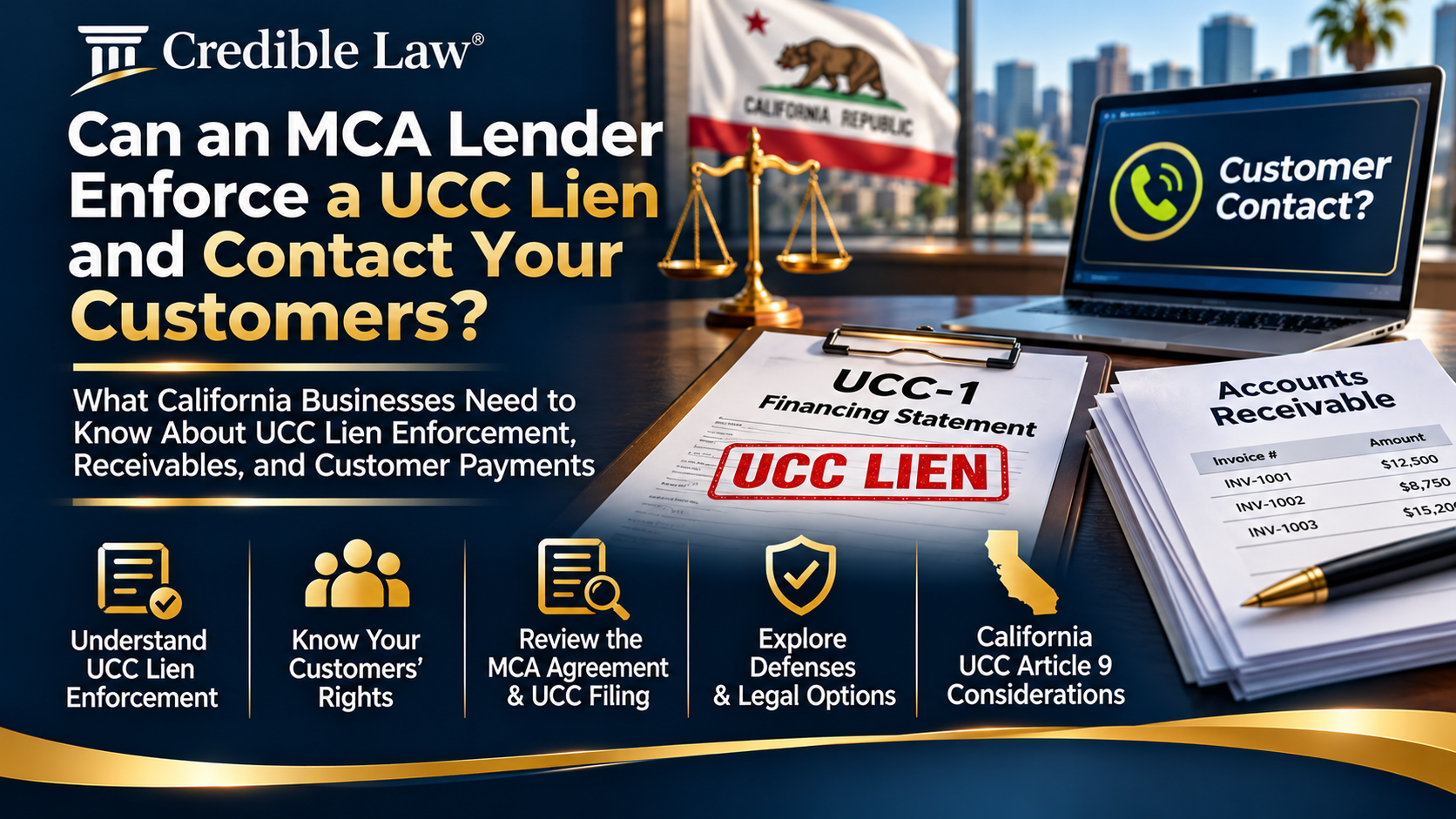
New California business-owner guidance examines UCC lien enforcement, merchant cash advance receivables disputes, customer payment demands, and the legal protections available when funders attempt to collect directly from clients.
San Diego, California / 500NewsWire / November 18, 2026 — A California business owner receives an unexpected call from a longtime customer. The customer explains that a merchant cash advance company has contacted its accounting department and demanded that future invoice payments be sent directly to the funder.
The business owner was not expecting the communication. The customer is confused about whom to pay, an outstanding invoice remains unresolved, and the business now faces the possibility of losing both incoming revenue and an important commercial relationship.
For companies facing this situation, one urgent question emerges: Can an MCA lender enforce a UCC lien and contact customers without first obtaining a court judgment?
Credible Law, a legal information and attorney referral resource, is highlighting the importance of understanding UCC lien enforcement, accounts receivable assignments, and the rights of businesses when merchant cash advance providers attempt to collect directly from customers.
Under certain circumstances, secured creditors and assignees may have legally enforceable rights to collect payments owed to a business. However, filing a UCC-1 financing statement does not automatically establish that every collection demand is valid or that a creditor has unrestricted authority over customer payments.
The legal analysis depends on the underlying agreement, the existence and scope of an enforceable security interest or assignment, the status of any default, and applicable state law.
For California businesses, those distinctions can be critical when customer relationships and operating cash flow are at risk.
What Is UCC Lien Enforcement in a Merchant Cash Advance Dispute?
UCC lien enforcement generally refers to the exercise of rights associated with a security interest governed by Article 9 of the Uniform Commercial Code.
Merchant cash advance agreements may include provisions concerning purchased receivables, security interests, collateral, default, and creditor remedies.
Some funders file UCC-1 financing statements identifying accounts receivable, payment rights, or other business assets as collateral.
A UCC-1 financing statement is a public notice filing. It is not itself a court judgment, and its existence does not conclusively establish that the funder has an enforceable security interest in every asset listed.
Under California Commercial Code Section 9203, enforceability of a security interest generally requires value, rights in the collateral, and satisfaction of an applicable security-agreement or control requirement.
These requirements are distinct from filing a financing statement.
A creditor may therefore have a public filing while disputes remain over the validity, scope, priority, or enforceability of the underlying interest.
For business owners, understanding this distinction is an essential starting point before responding to a funder's customer-payment demand.
Can an MCA Company Contact Your Customers and Demand Payment?
In some circumstances, yes.
California Commercial Code Section 9607 permits a secured party, if agreed and in any event after default, to notify an account debtor or another person obligated on collateral to make payment to or for the benefit of the secured party.
In this context, an account debtor generally means the customer or other party obligated to pay an account or qualifying payment right. It does not necessarily mean the business that received the MCA funding.
The law also recognizes certain enforcement rights concerning obligations owed on collateral.
However, whether a particular MCA provider can lawfully exercise those rights depends on the nature of the transaction, the funder's legal interest, the agreement, and the circumstances of the collection attempt.
A customer contact may raise important questions:
- Does the MCA provider have a valid assignment or enforceable security interest in the receivable?
- Does the agreement authorize collection before default, or has a legally relevant default occurred?
- Does the claimed collateral include the specific customer invoice?
- Was the customer given a legally sufficient notification of assignment?
- Has the customer requested proof of the assignment?
- Are there competing assignments, contractual defenses, or other limitations?
The answers may determine whether the customer should pay the business or the funder.
Business owners should not assume that all direct-payment demands are unlawful. They should also not assume that every demand must be accepted without verification.
California UCC Article 9: What the Law Says About Customer Payment Notices
California Commercial Code Section 9406 addresses the effect of certain assignment notifications on parties obligated to pay accounts, chattel paper, or payment intangibles.
Subject to statutory exceptions, an account debtor may generally discharge its obligation by paying the original creditor until receiving a qualifying notification that the payment right has been assigned and payment should be made to the assignee.
After receiving an effective notification, the account debtor may be required to pay the assignee to discharge the obligation.
Importantly, the statute also provides protections concerning the content and verification of assignment notices.
For example, a notification may be ineffective if it fails to reasonably identify the rights assigned.
The account debtor may also request reasonable proof that the assignment occurred.
If the assignee fails to provide the required proof, the statute may permit the account debtor to discharge the obligation by paying the original creditor.
These protections are particularly relevant when a customer receives an unexpected demand from a merchant cash advance company.
However, the statute contains exceptions and does not apply identically to every type of receivable or transaction.
Business owners and customers should obtain qualified legal guidance before deciding how to handle disputed payment instructions.
Five Warning Signs That MCA UCC Lien Enforcement Requires Immediate Review
1. Customers Receive Payment Diversion Notices Without Explanation
A business may first learn about a funder's collection efforts when customers report receiving emails, letters, or telephone calls.
The funder may claim that invoices have been assigned and that future payments must be redirected.
The business should preserve the communications and determine which receivables are identified.
A demand involving receivables outside the agreement's collateral description may require additional scrutiny.
2. The MCA Provider Claims Rights to All Business Receivables
Some funding agreements contain broad collateral descriptions.
However, the scope of a financing statement is not necessarily identical to the scope of the enforceable security interest or the assets actually sold.
The business should review the original funding agreement, security provisions, collateral description, and any amendments.
3. Multiple Funders Claim the Same Customer Payments
Businesses with stacked merchant cash advances may encounter competing claims against the same receivables.
Different funders may assert rights under separate agreements or financing statements.
Priority and entitlement depend on the relevant transactions and applicable law.
A customer receiving competing payment instructions should not assume that the most aggressive creditor has the superior claim.
4. A Funder Threatens Customers With Legal Action
A creditor's right to enforce a payment obligation does not establish that every statement made during collection is accurate or legally justified.
Businesses should preserve written demands, customer correspondence, and records of disputed representations.
An attorney can evaluate whether the communications accurately describe the creditor's rights and whether any actionable misconduct occurred.
5. Customer Payments Are Redirected and Payroll Is at Risk
For restaurants, transportation companies, contractors, wholesalers, healthcare providers, and other businesses, accounts receivable may represent essential operating cash flow.
Unexpected diversion of invoice payments can interfere with payroll, taxes, supplier obligations, and other expenses.
The business should identify the affected receivables and promptly evaluate its legal and financial options.
Does a UCC-1 Filing Give an MCA Lender the Right to Seize Receivables?
Not automatically.
A UCC-1 financing statement generally provides public notice of a claimed security interest and may serve a role in perfection and priority.
It does not independently create all the rights necessary to enforce a claim against a customer.
A secured party's rights depend on the underlying transaction, attachment and enforceability requirements, applicable perfection and priority rules, and relevant contractual or statutory remedies.
California Commercial Code Section 9502 addresses information required for a sufficient financing statement, including the debtor's name, secured party's name, and indication of collateral.
California Commercial Code Section 9203 separately addresses when a security interest becomes enforceable.
These provisions help explain why a public filing alone should not be treated as conclusive proof of a creditor's right to redirect payments.
California business owners seeking information about UCC lien enforcement and merchant cash advance disputes can review Credible Law's resource addressing financing statements, collateral claims, and potential legal responses.
Can an MCA Lender Enforce a UCC Lien Without Filing a Lawsuit?
Certain Article 9 enforcement rights may be exercised without first obtaining a court judgment.
California Commercial Code Section 9607 recognizes rights to collect or enforce specified payment obligations when the statutory conditions are satisfied.
Other enforcement methods may involve judicial proceedings, depending on the collateral and the remedy pursued.
For example, a direct notice concerning assigned accounts receivable is legally different from a judicial bank levy.
A merchant cash advance company's asserted right to collect invoice payments should not be confused with an unrestricted right to freeze an ordinary business deposit account.
Deposit-account enforcement can involve additional requirements, including rules concerning control.
The distinction is especially important when a funder threatens both customer collection and bank account restrictions.
What If a Customer Requests Proof of the Assignment?
A customer's request for documentation may be important when payment instructions change unexpectedly.
Under California Commercial Code Section 9406, qualifying account debtors may request reasonable proof of an assignment.
The legal consequences of failing to provide that proof depend on the statutory requirements and applicable exceptions.
Business owners should preserve copies of any assignment notices and proof requests.
They should also avoid instructing customers to disregard a potentially valid notice without understanding the legal consequences.
Where conflicting instructions exist, qualified counsel can evaluate the documents and advise the affected parties concerning their respective rights.
Can a California Business Challenge MCA UCC Lien Enforcement?
Potentially, depending on the circumstances.
A merchant cash advance agreement may raise questions involving contract interpretation, the nature of the funding transaction, collateral scope, default provisions, payment reconciliation, and creditor enforcement.
Some MCA transactions are structured as purchases of future receivables rather than conventional loans.
The legal characterization of a particular transaction depends on its terms, economic substance, and applicable law.
A business may also dispute whether a claimed security interest attached to particular collateral, whether a creditor is entitled to collect a specific receivable, or whether required procedures were followed.
Available remedies may include negotiated resolution, demands for clarification, litigation defenses, or other legally authorized action.
A business should not assume that an MCA agreement is unenforceable merely because it is expensive or financially burdensome.
Similarly, a creditor should not assume that a financing statement resolves every dispute over its enforcement rights.
What Business Owners Should Do in the First 24 Hours After a Customer Is Contacted
When an MCA funder contacts customers about outstanding invoices, business owners should act promptly to establish the facts.
Obtain the communication. Request a copy of the email, letter, or payment notice received by the customer.
Identify the receivables. Determine which invoices, contracts, or payment rights are involved.
Review the funding documents. Locate the MCA agreement, security provisions, assignments, guarantees, and amendments.
Check the UCC records. Obtain relevant financing statements and filing histories from the appropriate filing office.
Preserve payment records. Document payments already made, outstanding balances, and any reconciliation requests.
Identify competing claims. Determine whether other creditors or factors have asserted rights to the same receivables.
Seek qualified legal review. An attorney familiar with commercial secured transactions can evaluate whether the collection demand is supported by the applicable documents and law.
Business owners should avoid making misleading statements to customers, concealing collateral, or attempting to evade valid creditor rights.
The objective should be to identify the legal basis of the demand and resolve disputes through appropriate procedures.
What Happens If an MCA Company Contacts Customers After the Debt Has Been Paid?
A claimed assignment or security interest may require additional review when the underlying obligations have been satisfied.
The appropriate analysis depends on whether the transaction involved a secured obligation, an outright sale of receivables, or another arrangement.
California Commercial Code Section 9209 provides a release mechanism in certain circumstances when no secured obligation remains outstanding and the secured party has no remaining commitment to extend value.
That provision contains exceptions, including for certain sales of accounts, chattel paper, and payment intangibles.
Accordingly, a completed payoff does not necessarily resolve every assignment question without reviewing the underlying transaction.
Business owners should preserve payoff confirmations, settlement agreements, termination documents, and communications concerning release of collateral or payment rights.
When Should a Business Contact a Merchant Cash Advance Defense Attorney?
Legal review may be particularly important when a funder has contacted multiple customers, redirected substantial receivables, asserted conflicting collateral rights, threatened litigation, or interfered with business operations.
A qualified attorney may evaluate the financing documents, applicable Article 9 provisions, assignment notices, and available defenses.
Counsel may also assess whether negotiations or court intervention are appropriate.
Credible Law provides additional educational information about merchant cash advance defense attorneys and legal options for business owners dealing with funding disputes, collection activity, and creditor enforcement.
Credible Law operates as a legal information and attorney referral resource rather than a law firm. Legal representation, when available, is provided by appropriately licensed independent attorneys.
Frequently Asked Questions About UCC Lien Enforcement
Can an MCA lender contact my customers about unpaid invoices?
Potentially. Depending on the agreement and applicable law, a funder with an enforceable assignment or security interest may have rights to notify customers and seek payment. The validity and scope of the demand must be evaluated.
Does an MCA company need a judgment to enforce a UCC lien?
Not for every remedy. Certain Article 9 collection rights may be exercised without a prior judgment when the legal requirements are satisfied. Other remedies may require judicial proceedings.
Can a customer refuse to pay an MCA lender?
The answer depends on whether the customer received an effective assignment notification, whether proof was requested and supplied, and other applicable rights or defenses. Customers should not ignore potentially valid payment instructions without appropriate review.
Can an MCA lender collect more than the amount owed?
The creditor's entitlement depends on the agreement, applicable law, and the nature of the transaction. A business should review the claimed balance and collection rights rather than assume that any demanded amount is correct.
Can multiple MCA companies claim the same receivables?
Yes. Multiple creditors may assert competing interests. Determining priority and entitlement can require analysis of the underlying agreements, filing histories, and applicable law.
Is a UCC lien the same as a court judgment?
No. A UCC financing statement is generally a public notice filing associated with a claimed security interest. A judgment is a court determination that may support separate enforcement procedures.
Can a California business challenge an MCA funder's customer-payment notice?
Potentially. The business may have grounds to dispute the claimed assignment, collateral scope, default, or enforcement rights. Available remedies depend on the documents and governing law.
Credible Law Encourages Prompt Review When MCA Funders Contact Business Customers
Customer relationships and accounts receivable are essential to many small-business operations.
When a merchant cash advance provider attempts to redirect customer payments, the resulting uncertainty can affect working capital, payroll, vendor obligations, and commercial relationships.
California business owners should understand that UCC lien enforcement involves more than the existence of a financing statement.
The validity of the underlying security interest or assignment, the scope of the collateral, the applicable default and collection provisions, and the requirements governing customer notices all matter.
Early review may help businesses identify legitimate creditor rights, disputed demands, and available legal options before the situation escalates.
Has an MCA lender contacted your customers or demanded direct payment of your invoices? Call Credible Law at (888) 201-0441 to discuss available legal information and attorney referral options.
About Credible Law
Credible Law is a national legal information and attorney referral resource helping individuals and businesses access educational information about legal disputes and available legal assistance.
Its business-related resources address merchant cash advance agreements, UCC financing statements, commercial funding disputes, creditor collection activity, business bank account restraints, and related legal concerns.
Credible Law is not a law firm and does not itself provide legal representation. When available, legal services are provided by appropriately licensed independent attorneys. Contacting Credible Law does not establish an attorney-client relationship.
Media Contact
Credible Law
San Diego, California
Phone: (888) 201-0441
Website: https://crediblelaw.com/
Business and Legal Information Inquiries
Legal Disclaimer: This release is provided for general educational and informational purposes and does not constitute legal advice. UCC enforcement rights, assignment procedures, creditor remedies, and available defenses depend on the specific transaction and governing jurisdiction. Business owners should consult qualified legal counsel regarding their circumstances.