
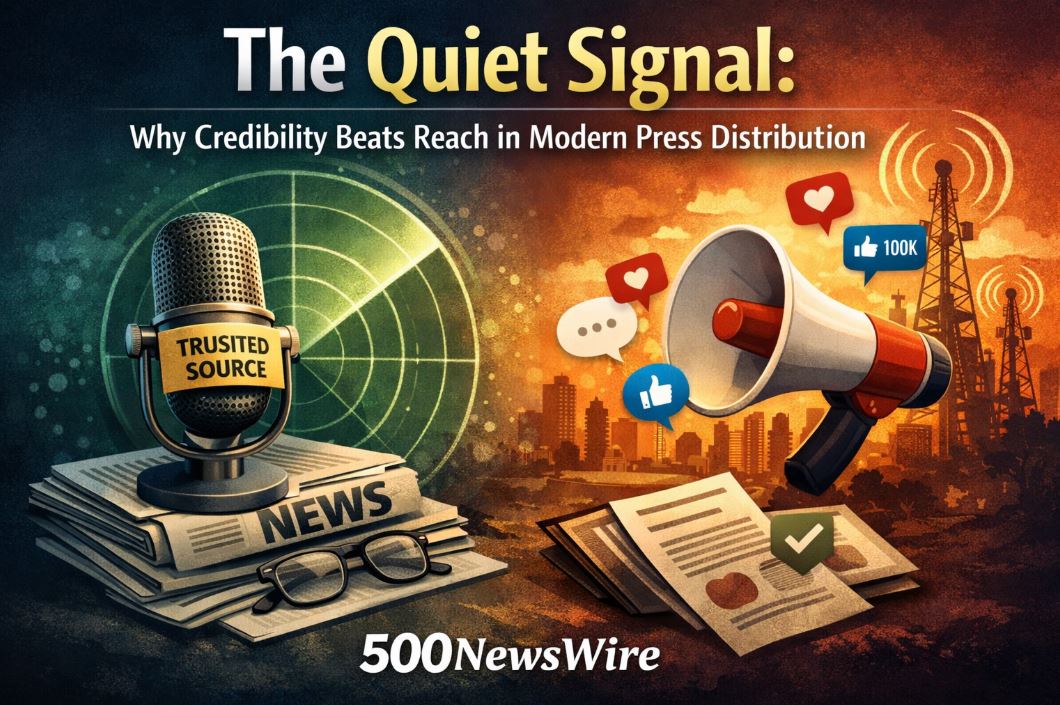
The Quiet Signal: Why Credibility Beats Reach in Modern Press Distribution
In the age of infinite content, the loudest message rarely wins. The most trusted one does.
For years, press distribution has been framed as a numbers game: more sites, more impressions, more backlinks. But something subtle—and important—has shifted. Editors, investors, partners, and even algorithms are no longer impressed by volume alone. They’re scanning for signals of credibility.
This is where modern press strategy quietly separates itself from outdated tactics.
The Attention Economy Is Overcrowded
Every day, thousands of press releases are published across the web. Many are technically “distributed,” but few are truly read. Fewer still influence decisions.
Why?
Because attention has become selective. Readers don’t ask, “How many sites picked this up?” They ask:
- Where did this appear?
- Does this outlet have editorial standards?
- Is this source trusted by people like me?
A release seen on five recognized financial or business platforms often carries more weight than one copied across 500 unknown domains.
Credibility Is a Multiplier, Not a Metric
Credibility doesn’t replace reach—it multiplies it.
When a press release appears on established media:
- Journalists treat it as a vetted signal, not noise
- Search engines interpret it as authority, not manipulation
- Readers assume legitimacy before reading a single word
This multiplier effect can’t be replicated by syndication alone. It’s built through association with outlets that already have trust.
Distribution vs. Placement: A Strategic Difference
Traditional distribution pushes content everywhere. Strategic placement puts content somewhere specific.
Think of it this way:
- Distribution answers: How far did it go?
- Placement answers: Who noticed?
Modern PR professionals increasingly prioritize placements that align with:
- Industry relevance
- Geographic influence
- Investor or partner visibility
The result is fewer appearances, but stronger outcomes.
Algorithms Are Watching More Than Links
Search engines have grown sophisticated. They don’t just count links—they evaluate context.
Signals that matter today include:
- The reputation of the publishing domain
- Editorial consistency
- Reader engagement and dwell time
- Cross-citation by other credible sources
A single release published on a respected platform can outperform dozens of low-quality reposts in long-term search value.
Trust Travels Further Than Traffic
A trusted article is more likely to be:
- Quoted by journalists
- Shared by professionals
- Referenced in investor decks
- Used in due diligence
Traffic spikes fade. Trust compounds.
That’s why companies increasingly view press releases not as announcements, but as reputation assets.
What This Means for Brands Today
For startups, enterprises, and growing brands, the takeaway is clear:
- Visibility without credibility is fragile
- Reach without trust is temporary
- Media reputation is a long-term advantage
Choosing where a story appears is now as important as what the story says.
The Quiet Advantage
In a noisy media landscape, the strongest signal is often the quietest one—the appearance in the right place, read by the right people, at the right time.
Press distribution isn’t dead. It’s evolving.
And credibility is leading the way.
This article was written exclusively for 500NewsWire to reflect emerging shifts in modern press and media strategy.