
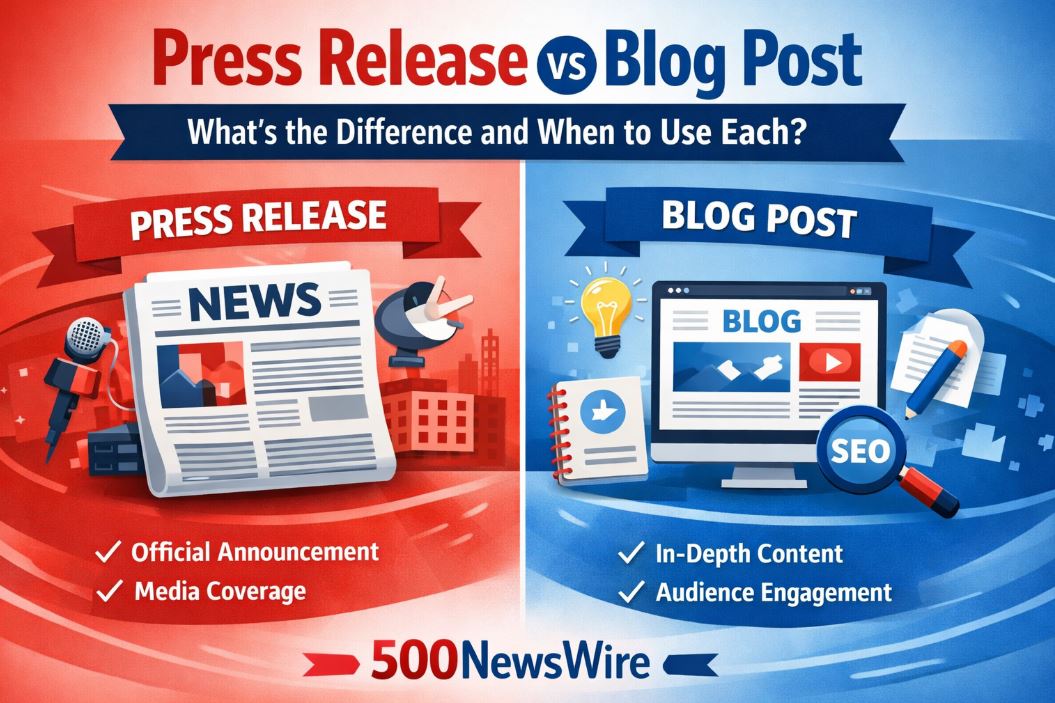
Press Release vs Blog Post: What’s the Difference and When to Use Each?
In today’s digital world, businesses share information in many ways. Two of the most common content tools are press releases and blog posts. While they may look similar at first, they serve very different purposes.
Many businesses ask the same question:
Should I write a press release or a blog post?
The answer depends on what you want to say, who you want to reach, and why you are sharing the information. In this article, we explain the difference between a press release and a blog post in very simple terms, and when you should use each one.
What Is a Press Release?
A press release is an official news announcement. It is written to share important, newsworthy information with media outlets, journalists, investors, and the public.
Press releases are usually used when a company has real news to share, such as:
A company launch or expansion
A new product or service
A business partnership
Funding or investment news
Awards or recognitions
Major company updates
A press release follows a clear and structured format. It answers basic questions like:
What happened?
Who is involved?
When did it happen?
Where did it happen?
Why does it matter?
The language is formal, factual, and neutral. It avoids opinions and promotional words. The goal is to inform, not to sell.
When distributed through a digital press release platform like 500NewsWire, a press release can appear on:
News websites
Google News
Financial platforms
Business publications
This helps businesses gain media visibility and credibility.
What Is a Blog Post?
A blog post is a piece of content published on a company’s website or blog section. It is used to educate, explain, guide, or share opinions.
Blog posts are more flexible and informal than press releases. They are often written to:
Explain a topic in detail
Share industry knowledge
Answer common questions
Improve website SEO
Build long-term audience trust
Examples of blog topics include:
How-to guides
Industry trends
Tips and advice
Case studies
Opinion pieces
Blog posts are usually written in a friendly, conversational tone. They can be longer, more detailed, and include examples, images, and internal links.
The main audience for blog posts is customers, readers, and website visitors, not journalists.
Key Differences Between Press Releases and Blog Posts
Let’s break it down in a simple way.
1. Purpose
Press Release: To announce news
Blog Post: To educate or inform
2. Tone
Press Release: Formal and professional
Blog Post: Casual and friendly
3. Audience
Press Release: Journalists, media, investors, public
Blog Post: Customers, readers, website visitors
4. Structure
Press Release: Follows a strict format
Blog Post: Flexible structure
5. Length
Press Release: Usually 400–700 words
Blog Post: Can be 600–2,000+ words
6. Distribution
Press Release: Distributed through press release platforms
Blog Post: Published on a website and shared on social media
When Should You Use a Press Release?
You should use a press release when you have real news.
Ask yourself these questions:
Is this information new?
Would journalists find this useful?
Does this update affect customers, investors, or the market?
If the answer is yes, a press release is the right choice.
Examples of when to use a press release:
Launching a new business
Announcing a partnership
Expanding into a new market
Sharing financial or funding news
Making an official company statement
A press release helps your news reach a wider audience beyond your website. It also adds trust, because news platforms only publish factual announcements.
When Should You Use a Blog Post?
You should use a blog post when you want to explain something in detail or build long-term visibility.
Ask yourself:
Am I trying to teach something?
Is this content evergreen?
Do I want to improve my website traffic?
If yes, a blog post is the better option.
Examples of when to use a blog post:
Explaining how your service works
Sharing industry tips
Answering customer questions
Writing SEO-focused content
Building thought leadership
Blog posts are excellent for search engine optimization (SEO). Over time, they can bring steady traffic to your website.
Can You Use Both Together?
Yes, and this is often the best strategy.
Many businesses use press releases and blog posts together.
For example:
You publish a press release to announce a new product
You publish a blog post explaining how the product works
The press release brings news visibility, while the blog post provides detailed information for interested readers.
This combination helps you reach both:
Media platforms
Your target audience
Which One Is Better for SEO?
Both can help SEO, but in different ways.
Blog posts help SEO by ranking for keywords and driving organic traffic to your website.
Press releases help SEO by building brand mentions, backlinks, and visibility on high-authority sites.
When distributed properly, press releases can appear in Google News and business search results, which adds strong credibility.
Common Mistakes to Avoid
Many businesses make these mistakes:
Writing promotional sales content as a press release
Posting company news only as a blog post
Mixing opinions into press releases
Ignoring blog content after publishing news
Each format has its own role. Using the wrong one can reduce impact.
Final Thoughts
Press releases and blog posts are not competitors. They are different tools with different purposes.
Use press releases to share official news and reach media platforms
Use blog posts to educate, explain, and grow long-term website traffic
When used correctly, both can work together to strengthen your brand’s online presence.
For businesses looking to share news professionally and reach trusted media platforms, digital press release distribution remains a powerful and reliable option.